A prehistoric tool at the dollar store
Why the sewing needle hasn't changed in 40,000 years
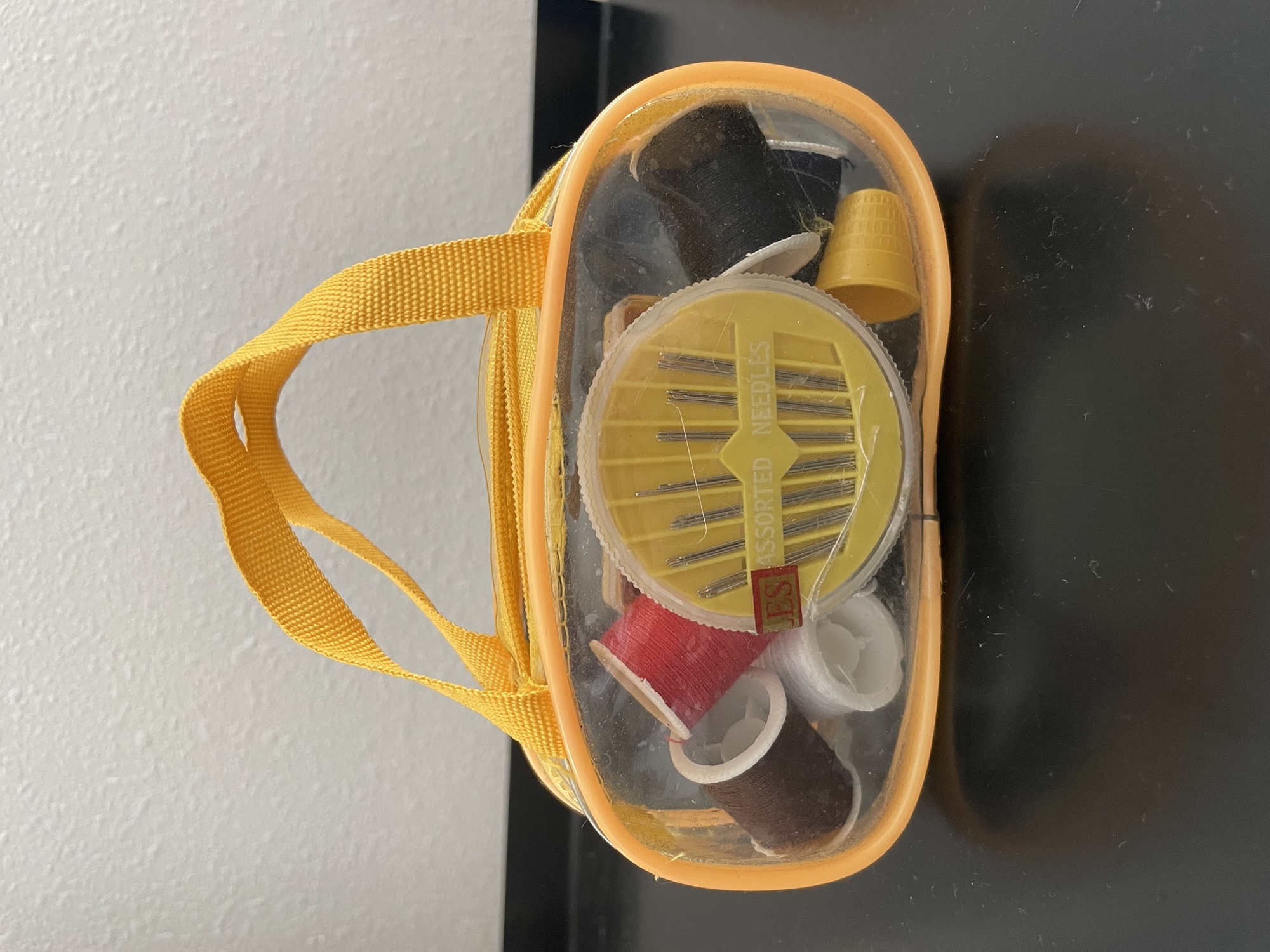
Walk into a Dollar Tree and you can find one of humanity's oldest tools. Find one of those cheap sewing kits with the plastic zip bag and a couple mismatched buttons and you'll see a few slender needles piercing a thin scrap of paper. They are almost unremarkable — a shiny point, an eye... that's it. Nothing about them announces the fact that this exact form is older than agriculture, pottery, or the wheel.
A 2024 survey of every confirmed Paleolithic eyed-needle site (Gilligan et al., Science Advances) traces the earliest examples back roughly 40,000 years, to Denisova Cave in Siberia. The cave was occupied by several different human groups over that span — Denisovans, Neanderthals, and eventually Homo sapiens — so exactly who made the first one is still debated. What isn't in question is the timing: the technology existed deep in the Paleolithic. A few thousand years later, the same tool turns up again and again across the continent with early modern humans: the Caucasus around 38,000 years ago, East Asia around 30,000, and Europe by 26,000.
The invention of the eyed needle allowed for tighter, more weatherproof seams than awls or draped hides alone typically achieved. Better-fitted clothing improved insulation and thermoregulation, and the needle likely contributed to modern humans' ability to migrate into colder climates during the Ice Age.
13,000 years ago and an ocean away, we get a peek into the setting for this technology from a Paleoindian mammoth-kill site in what's now known as Wyoming. The bone needles recovered from the site were made from fox, hare, and felid — small fur-bearing animals that were likely being hunted for their pelts, the raw material for tailored clothing. A scene of community, creativity, and resourcefulness that feels fundamentally human.
What's changed since is only what the needle is made of, not what it does. Bronze and iron turn up in Viking Age graves on Gotland, a metal intermission between bone and industrial steel, which has dominated since the 19th century. The core mechanism — a point to lead thread through fabric, an eye to carry it — hasn't needed to change. Picking up that sewing kit you'll find essentially the same geometry you find at a prehistoric site.
So did human ingenuity run out? Or is it the opposite? The sewing needle points toward another possibility: sometimes a design reaches a point where every meaningful constraint has already been solved for. The problem was narrow enough — human hands, freezing temperatures, the material properties of bone, steel, fabric, and hide — that there continues to be only one good answer. Some objects don't endure because no one thought to improve them — they endure because they've already been perfected.
Sources
- Pelton, S.R. et al. "Technological organization of eyed bone needle production at La Prele Mammoth site (48CO1271), Wyoming." PLOS ONE, 2024. https://doi.org/10.1371/journal.pone.0313610
- "Ancient Needles." University of Pennsylvania Museum Bulletin, vol. 9, no. 1. https://www.penn.museum/documents/publications/bulletin/09-1/ancient_needles.pdf
- Sewing needle, bronze, Viking Age. Swedish History Museum, via Wikidata. https://www.wikidata.org/wiki/Q123461223 and https://www.wikidata.org/wiki/Q123461235
- Sewing needle, iron, Viking Age. Swedish History Museum, via Wikidata. https://www.wikidata.org/wiki/Q123461583
- Howe, David Ian. "Why a Clovis bone needle is the most important artifact in North America. | The LaPrele Mammoth Site." YouTube, 2024 (interview with paper co-authors Spencer Pelton and McKenna Litynski). https://www.youtube.com/watch?v=bbxcJ4Ui41Y
- Gilligan, I., D'Errico, F., Doyon, L., Wang, W., Kuzmin, Y.V. "Paleolithic eyed needles and the evolution of dress." Science Advances, 2024. https://doi.org/10.1126/sciadv.adp2887