Door hinge
A jointed mechanical fastener that lets a door rotate on a fixed axis while remaining attached to its frame.
Classification
- Mechanisms
- pivoting
- Tasks
- join
- Materials
- steel, brass
- Historical materials
- bronze pivot pins and leaves, iron pivot pins and leaves (wrought iron, colonial-era strap and H-hinges), wood pivot-sockets (earliest pivot-door forms, pre-dating leaf hinges)
Principles
A fixed pivot axis lets one rigid body rotate relative to another while constraining all other degrees of freedom;the butt hinge's knuckle-and-pin design (two interleaved leaves joined by a pin) is the dominant modern form;distributes the door's weight across two or more leaves fastened to frame and door, rather than a single pivot point.
Evolution
- ~3200 BCE (Hierakonpolis, Egypt)
Pivot socket[1]
The door's own wood pivot turned directly in a carved stone socket — no leaf or pin.
- 1630–70
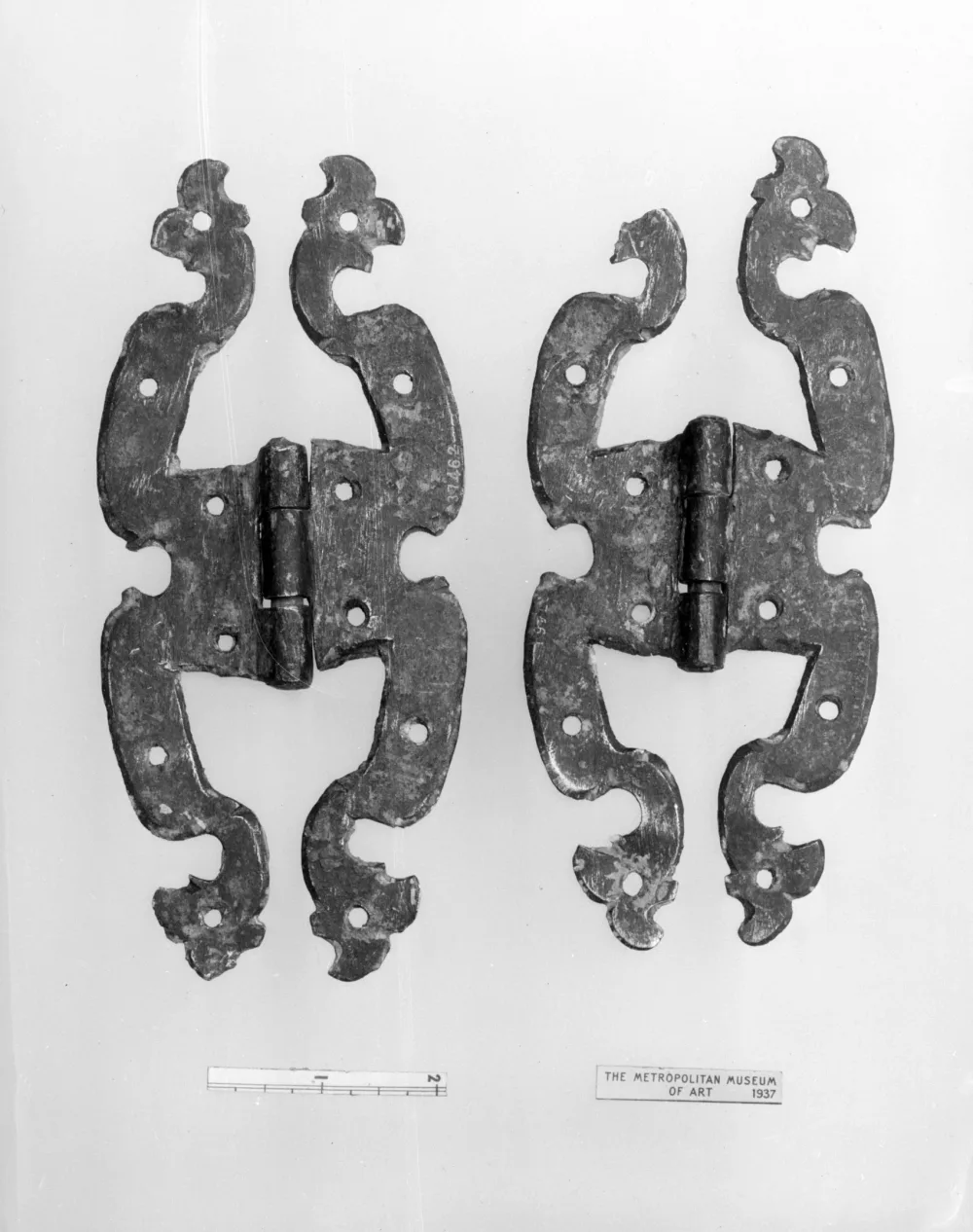
Metropolitan Museum of Art. Rogers Fund, 1937. Public Domain (Open Access).
Wrought iron strap hinge[2]
A leaf-and-pin hinge, the form the modern butt hinge descends from.
- 19th century – present
Butt hinge[3]
Two interleaved leaves joined by a pin — the dominant modern form.
Related objects
- door
- latch
- cabinet hinge
- piano hinge
- pintle
- doorknob
- deadbolt