Broom
A hand tool with bristles fixed to the end of a handle, used to sweep loose debris from a surface.
Classification
- Mechanisms
- wiping, abrading
- Tasks
- sweep, clean
- Materials
- broomcorn fiber, synthetic fiber (nylon, polypropylene), plastic or wood handles
- Historical materials
- grass, broomcorn (Sorghum bicolor) straw, twigs and branches (besom-style), broom plant bristle (Genista/Cytisus), wood
Principles
Bristles catch and drag loose particles via friction;flexible bristles conform to surface irregularities;handle extends reach and applies leverage, reducing bending.
Evolution
- ~1981–1975 BCE (Egypt)
Grass sweeping implement[1]
Cataloged by the Met as "brush," not "broom" — the terminology is blurry this early. Made of grass, from the tomb of Meketre at Thebes.
- ca. late 2nd century BCE – late 2nd century CE (Han dynasty)
Split-cane broom fragment (Han-dynasty China)[2]
A broom head built up from bundles of split cane slivers, bound in stages rather than tied once: a first handful lashed with string wound twice near the end, then a second bundle laid against the first and lashed through and around the first binding in turn. Excavated from a Han-dynasty frontier watch-station (T.XIII) on the Great Wall near Dunhuang, in the arid Gansu desert — dry conditions unusual enough to preserve an organic broom that would otherwise have rotted away.
- undocumented, longstanding traditional form
Besom[3]
A bundle of birch twigs bound around a handle with two binds of willow or wire, giving a rounded head; the head is fixed to the handle with a nail or a wooden peg driven through a bored hole. No fixed invention date for the form itself, but the Tadley besom-making trade in Hampshire, England is documented back to at least the 14th century.
- 19th century – present
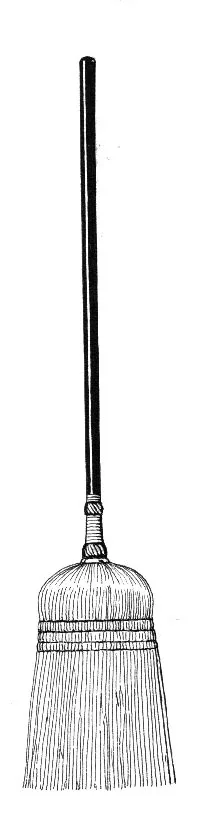
Wikimedia Commons. Pearson Scott Foresman. Public Domain.
Corn broom[4]
Made from broomcorn (Sorghum bicolor) fiber lashed to a handle. By 1800, Shaker Brother Theodore Bates of the Watervliet, New York community had invented a broom vise that clamped and fanned the fiber bundle so it could be stitched flat with twine — replacing the round bundle with the flat-headed shape that became standard.
- mid-20th century
Synthetic bristle broom[5]
Bristles extruded from synthetic polymer fiber rather than plant material — more durable and water/insect/rot-resistant than natural fiber, with more consistent stiffness.
Textual evidence
- ca. 2000 BCE composition; surviving manuscripts copied in the early 2nd millennium BCE (Old Babylonian period), most from Nippur.
Two Women B (Sumerian literary text)[6]
A Sumerian disputation in which two women trade insults over which of them is the better wife. One accuses the other of failing basic housework; the line reads "she sweeps the house (and) sprinkles it" — sweeping cited as a marker of a properly kept household.
- Dead Sea Scrolls, ca. 125 BCE.
Isaiah 14:23 (Hebrew Bible)[7]
A metaphorical use, not a literal broom: "I will sweep it with the broom of destruction" (NRSVUE), part of a taunt announcing Babylon's total ruin. Using the broom as an image for complete sweeping-away only works if the tool and its function were already ordinary to the text's audience.
Articles
- The Broom ClosetSeptember 2, 2026
Related objects
- brush
- besom
- whisk broom
- dustpan
- mop
- carpet sweeper
- vacuum cleaner
- broomcorn
Sources
- 1.The Metropolitan Museum of Art, "Brush," object 562010
- 2.British Museum, "broom," registration MAS.776, excavated by Sir Aurel Stein (Second Central Asian Expedition, 1906–08), published in Stein, Serindia: Detailed Report of Archaeological Explorations in Central Asia and Westernmost China (1921), p. 778.
- 3.Heritage Crafts Association, "Broom (Besom) Making"
- 4.Shaker Museum (Chatham, NY), "How the Shakers Improved These 4 Everyday Objects," citing Jerry Grant, Director of Library and Collections
- 5.University of Birmingham, "A History of Nylon — War, Riots and Toothbrushes"
- 6.Jana Matuszak, edition and translation, text Q000771 ("Two Women B"), ORACC ePSD2; full critical edition in Matuszak, "Und du, du bist eine Frau?!" Editio princeps und Analyse der sumerischen Disputation "Zwei Frauen B" (De Gruyter, 2021).
- 7.Hebrew Bible, Isaiah 14:23, NRSVUE, via BibleGateway